
ResourcesBlog
GPUStack Auth Bypass Gave Attackers Admin Access With No Login
GPUStack fixed an auth bypass scored 9.8. Attackers had already used it in the wild. Update to 2.2.2 or later.
Leonard EsereReading time 5 min
Filed underGPUStackCVE-2026-102895auth bypassAI toolingevidence
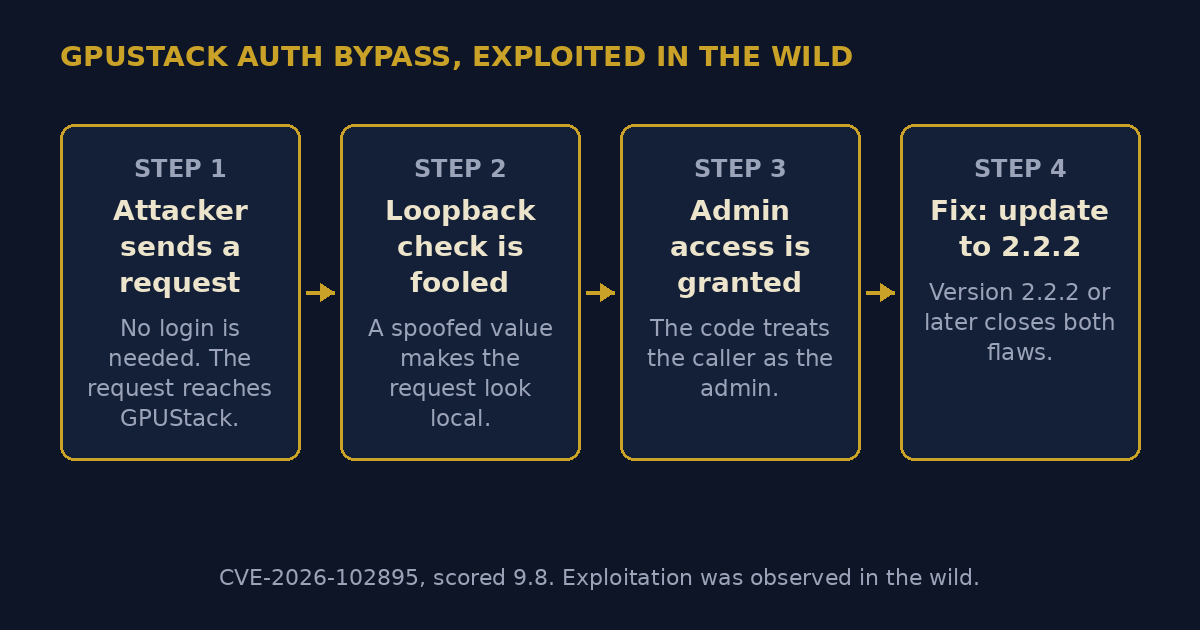
- A remote request could look local and gain admin access with no login.
- Attackers used the flaw in the wild against a 2.1.1 deployment.
- Update to 2.2.2 or later to fix this flaw and a sibling SAML flaw.
- After the update, test the admin path and rotate exposed secrets.
GPUStack is an open source GPU cluster manager. It serves AI models and provisions GPU instances. A flaw in its login check gave remote attackers admin access. No login was needed. Attacks were already seen in the wild.
The flaw
The record is CVE-2026-102895. Common Vulnerabilities and Exposures (CVE) is the public record system for flaws. GitHub, Inc. is the CNA for this record. CNA means CVE Numbering Authority. The score is 9.8 on the Common Vulnerability Scoring System (CVSS) version 3.1. That score comes from GitHub as CNA. The National Vulnerability Database (NVD) has not yet provided its own score. The vector is CVSS:3.1/AV:N/AC:L/PR:N/UI:N/S:U/C:H/I:H/A:H. All builds before 2.2.0 are affected. Version 2.2.0 fixed the flaw.
The code sits in gpustack/api/auth.py. A function named get_current_user checked the request source. It treated a loopback request as the built in administrator. That happened when force_auth_localhost was false. False was the default setting. A remote request could look like it came from 127.0.0.1. The client_ip_getter code accepted a same host reverse proxy peer. It also accepted a client supplied X-GPUStack-Real-IP loopback value. Either path fooled the check. The weakness types are CWE-287, CWE-290, and CWE-346. CWE means Common Weakness Enumeration.
What attackers could do
Admin access opened the whole system. Attackers could change users and models. They could create a lasting admin API key. They could read worker secrets and cloud provider secrets. They could run code through POST /v2/inference-backends/from-yaml. That endpoint builds an inference backend from YAML input. YAML means Yet Another Markup Language, a plain text data format.
SecurityOnline reported on November 5, 2026 that researcher Javier Sixto of ulex.fr reported active attacks. Intruders used custom backends for reverse shells on worker hosts. A reverse shell gives an attacker a command line on the host. That turns a login flaw into full host control.
The NVD description states the key fact in plain words. It says, "Exploitation was observed in the wild against a 2.1.1 deployment". That sentence matters. It means patching is not a drill. It is a response to live attacks.
A second flaw in the same update path
A sibling flaw needs the same attention. The record is CVE-2026-102894. It scores 9.1. Its SAML callback trusted an unverified SAMLResponse. Security Assertion Markup Language (SAML) is a login standard for single sign on. The flaw allowed auth bypass and account takeover. Version 2.2.2 fixed it. Teams should update to 2.2.2 or later. That one update fixes both flaws.
What to do now
First, list every GPUStack deployment. Record the version on each one. Second, update each deployment to 2.2.2 or later. Third, test the fix on the live system. Send a remote request with no login. Confirm it no longer gains admin access. A ticket that says patched is not proof. A test on the live system is proof.
Fourth, hunt for signs of past access. Look for new admin users. Look for new API keys. Look for new inference backends. Look for odd processes on worker hosts. Fifth, rotate secrets that an attacker could have read. That includes worker secrets and cloud provider secrets. Rotate them even if the hunt finds nothing. A quiet break in leaves no log line to find.
This flaw has no listing in the Known Exploited Vulnerabilities (KEV) catalog in the sources checked for this story. KEV is run by the Cybersecurity and Infrastructure Security Agency (CISA). The lack of a KEV listing does not lower the risk. Live exploitation is already confirmed in the NVD record.
The governance lesson
The flaw came from a default. A local trust shortcut was left on. It treated a network claim as proof of identity. That is the lesson for every team. A default that grants admin access must be checked. Evidence must prove the fix works. A version number alone does not prove it. A dated test does.
Sources
- CVE-2026-102895 record, CVE Program. Auth bypass in GPUStack, fixed in 2.2.0.
- National Vulnerability Database (NVD) record for CVE-2026-102895. Score 9.8 from GitHub as CNA. Exploitation observed in the wild against a 2.1.1 deployment.
- GitHub security advisory GHSA-gj9m-f8ph-pmhr. https://github.com/gpustack/gpustack/security/advisories/GHSA-gj9m-f8ph-pmhr
- GPUStack release 2.2.0. https://github.com/gpustack/gpustack/releases/tag/v2.2.0
- CVE-2026-102894 record, CVE Program. SAML callback flaw, fixed in 2.2.2.
- SecurityOnline coverage, November 5, 2026. It reports active attacks found by researcher Javier Sixto of ulex.fr. Intruders used custom backends for reverse shells on worker hosts.
- Original diagram by PolicyCortex.
Next step
Update every GPUStack deployment to 2.2.2 or later. Then test the admin path and file the dated proof.
- Which GPUStack versions are affected?
- All builds before 2.2.0 are affected. Version 2.2.0 fixed this flaw. Version 2.2.2 or later also fixes the sibling SAML flaw.
- Was the flaw exploited in the wild?
- Yes. The National Vulnerability Database (NVD) record states that exploitation was observed in the wild against a 2.1.1 deployment.
- What should teams do after updating?
- Test that a remote request no longer gains admin access. Check for new admin accounts and keys. Rotate worker and cloud secrets that may have been exposed.
Related records
Guides and articles describe the work. The evidence that work produces is described in three proof pages and one architecture page.
- proof.state
- Proof of State. What the environment was, as of a date someone else picks: point-in-time records, content hashed and chained.
- proof.change
- Proof of Change. Who or what altered the environment, under what authority, with before and after state hashes.
- proof.agency
- Proof of Agency. What a machine was permitted to do before it acted, what it did, and what would have stopped it.
- architecture
- Architecture. How the chain is built and where it lives: inside your tenant, with no egress of evidence.
Further reading in this register
- FBI and CISA Warn That Attackers Are Targeting Refrigeration ControllersA joint advisory dated November 5, 2026 warns that attackers target refrigeration controllers in grocery and cold storage sites. The fix starts with removing internet exposure and changing default passwords.
- Airbyte Connector Builder Flaw Is Being Exploited, Patch to 2.2.0Airbyte fixed a critical Connector Builder flaw in version 2.2.0. JPCERT/CC confirms attackers are already using it. Airbyte 1.x gets no fix.
- Zyxel GS1900 Zero-Day Hit Nearly 1,000 Switches After a Patch Missed ItZyxel patched a GS1900 zero-day on October 22, 2026. Attackers had already used it to take over 996 switches. The June fix did not stop it.
Verify the record this entry describes.
- Published
- Last updated
- Unchanged since publication
- Author
- Leonard Esere